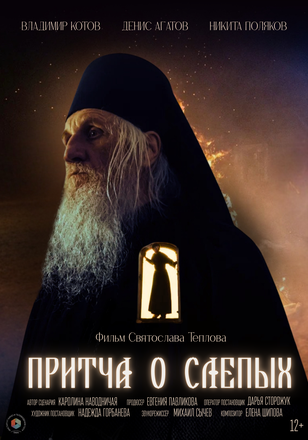
2026 | Fiction | 20 min. | Russia
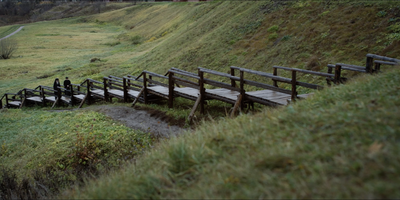
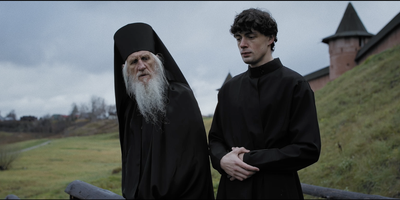
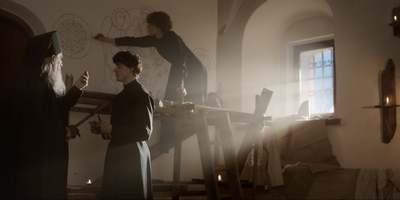
An Elder and his disciples, Alexei and Dmitry, paint an ancient temple far from worldly bustle. One rainy evening, a mysterious merchant arrives. Over supper, a debate sparks: is it easier to keep holiness away from temptation than to hold onto faith amid worldly lures and grief? By morning, the guest vanishes with the youngest disciple. The Elder sets out for the city to find Dmitry and test what his and his disciples' faith can withstand beyond solitude.
Directors Statement
At the heart of The Parable of the Blind lies a question that stayed with me throughout the entire making of the film: is it possible to preserve one's spiritual grounding in a world where human desires, pleasures, and temptations constantly put it to the test? Sometimes, the pursuit of what we want gradually blinds us to what truly matters. It was this very contradiction that formed the core concept of The Parable of the Blind. The story is based on an untitled short story by Anton Chekhov, which served as my inspiration for creating the film. The starting point for the visual concept was Olesya Stroeva's book Art and Philosophy, particularly its reflection on the Apollonian and Dionysian principles. In this opposition, I saw an opportunity to express the film's central inner conflict through the language of cinema itself. We built the world of the monks drawing on the aesthetics of iconography: symmetry, restrained composition, and a palette of whites, grays, and dark browns with subtle gold accents. The world of the city, by contrast, is inspired by Impressionist painting: rich reds, ultramarines, and oranges, heightened emotion, and visual chaos. Working with sound became a discovery in its own right. Almost all Foley and ambient sounds had to be recreated in the studio, allowing us to craft a distinct sonic environment in which silence took on dramatic weight. I wanted to make a parable film in which religious imagery is not an end in itself, but a way of speaking about human nature beyond time and circumstance.
Director: Svyatoslav Teplov
Producer: Evgeniya Pavlikova
Сast: Vladimir Kotov, Denis Agatov and Nikita Polyakov
Studio: Institute of Film and Television (GITR)